Points rummy
A single deal. Each player pays for the value of the cards left in hand at the show. The points cap, the drop penalty and the joker rules are stated plainly below.
The directory is a reader's map of the formats that fall under the rummy and skill-card family. For each, a plain statement of the rules, the scoring mechanic, the points cap and the show. No jackpot claims, no fabricated payouts, only what a player would actually see at the table.
A single deal. Each player pays for the value of the cards left in hand at the show. The points cap, the drop penalty and the joker rules are stated plainly below.
Played until a player or team reaches the elimination score (101 or 201). Each deal settles into the pool; the loser of the deal takes the full score.
Three deals per game. The chips move with the score, and the player with the most chips at the end of the third deal wins.
A ten-card variant. Knock when deadwood is ten or less; undercut the knocker with a lower deadwood count to win double.
Three-card hand. Trail, blind, seen, packed. Variations include AK47, Muflis and 3+2 Joker.
A single joker card is dealt face-up. Cards are dealt alternately to Andar and Bahar until a matching suit appears. The side that receives the match wins.
Dealer-led games broadcast from a studio. Game show variants such as Dream Catcher and Crazy Time fall in a different regulatory bucket.
Points rummy is the format a new reader should learn first. It is the cleanest expression of the rules, and it does not introduce the additional pressure of an elimination score or a chip count.
Thirteen cards are dealt face-down to each player. Two decks of cards are usually shuffled together with two printed jokers, making a total of 54 cards in play plus one face-up joker (the wild joker). The next card is placed face-up on the table to start the discard pile; the remainder becomes the closed deck.
On each turn, a player draws one card, either the face-up card from the discard pile or the top of the closed deck, and discards one card face-up. The turn order is clockwise from the dealer.
A player who believes their hand is valid declares a show. The cards are arranged into sequences and sets, the validity is checked, and the loser pays the winner the value of the cards left in hand.
The points cap is the maximum score a single declaration can produce. The cap was historically 60; several platforms reviewed this month have raised it to 80. The cap protects a strong hand from an outsized score.
A player may drop before picking their first card (first drop, 20 points) or after picking at least one card (middle drop, 40 points). A full count, declared but invalid, is 80 points.

Pool rummy is the most-played format on most mainstream platforms. The mechanic is simple: every deal settles a score into the pool, and the first player to reach the elimination score is out. The remaining players share the pool proportionally to their chip count.
The two common pool sizes are 101 and 201. A 101 pool usually lasts two to three hours; a 201 pool can run longer. Some platforms also offer shorter 61-point pools for quick sessions.
Each player buys in for the agreed chip count. Chips move on every deal; a player with zero chips can re-buy once. The re-buy cap depends on the platform, usually one re-buy per pool.
Longer pools reward patience and discipline. A player who takes a fifty-point hit in a 101 pool needs three clean wins to recover; the same hit in a 201 pool is half as painful. The strategy ledger expands on this.
Deals rummy is the chip-driven format. The game is fixed at three deals; the player with the most chips at the end of the third deal wins. The format rewards a strong start: a player who wins the first deal with a high score sets the tone.
The opening deal sets the stake. Each subsequent deal moves chips equal to the stake between the winner and the loser. A tied deal (everyone drops) returns the stake to the pool.
Three is the smallest number that lets skill catch up with variance. A player who wins the first deal but plays the second and third poorly will lose. A player who plays a quiet first deal and finishes strong will catch up.
Gin rummy is the western cousin of Indian rummy. Each player is dealt ten cards. The objective is to form melds, sets or runs, so that the unmatched cards, the deadwood, total ten or fewer points. A player may knock when their deadwood is ten or less; the knocker's deadwood is compared to the opponent's. If the opponent can lay off cards and undercut the knocker's deadwood, the opponent wins double.
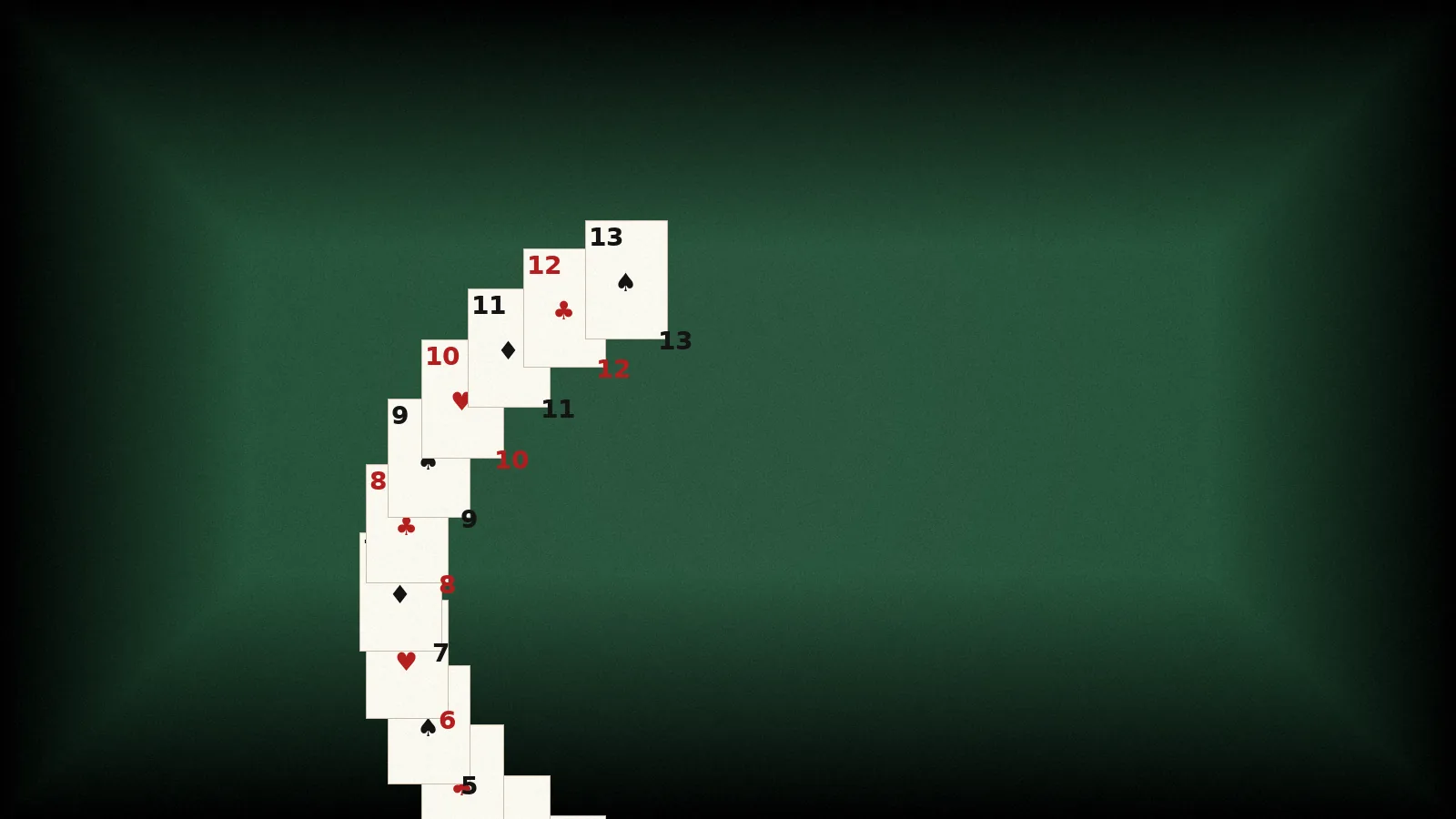
Teen patti is a three-card game of skill played for a fixed stake. Each player receives three cards face-down. The betting is in clockwise order: the player to the left of the dealer plays blind (without seeing their cards), then seen, then packed or raised.
From highest to lowest: Trail (three of a kind), Pure Sequence, Sequence, Colour, Pair, High Card. Variations such as AK47, Muflis and 3+2 Joker adjust the ranking or the joker mechanic.
Andar bahar is a single-joker mechanic. The dealer turns one card face-up; cards are then dealt alternately to the Andar and Bahar sides until a card of the same suit appears. The side that receives the match wins. The game is straightforward but the betting pattern rewards patience.
The how-to-play desk walks a new reader from the deal to the show in thirteen steps.
Points rummy ends after a single deal and pays out on the score. Pool rummy continues until a player or team reaches the elimination score, after which all remaining players share the pool.
Points rummy with a low stake is the cleanest starting point. The single deal teaches the rules without the additional pressure of an elimination score.
The points cap is the maximum score awarded for a single declaration. The cap was historically 60; several platforms have raised it to 80.
No. Gin rummy uses a ten-card hand and a different knocking mechanic. Indian rummy uses a thirteen-card hand and a show with sequences and sets.
Teen patti is usually played for a fixed stake per hand; the highest three-card hand wins the pot. Variations include AK47, Muflis and 3+2.
A step-by-step walkthrough from the deal to the show.
Open →What experienced readers actually do at the table.
Read →Where the rule sheet matches the implementation.
Compare →The four-step verification stack explained.
Open →Choosing a format is partly a question of taste and partly a question of how the reader plans to spend the next hour. The notes below are written for a reader who has not yet chosen a format and wants a clean, side-by-side comparison rather than another rule sheet.
Points rummy is the shortest format. A single deal usually runs between five and twelve minutes, with a thirty-second default turn timer on most reviewed platforms. A reader who plans a one-hour session can complete six to ten deals comfortably. Pool rummy is the longest. A 101 pool usually runs between ninety minutes and three hours depending on the table; a 201 pool can run longer. Deals rummy is fixed at three deals and usually runs between thirty and forty-five minutes. Gin rummy with a ten-card hand is faster than Indian rummy and usually completes inside six minutes per deal.
Points rummy carries the highest per-hand variance because the deal is short and the result is binary. A reader who plays ten deals in a session can lose the first seven and win the next three. The variance is built into the format. Pool rummy reduces variance over the longer horizon because the chip count smooths individual results. Deals rummy sits in the middle. Gin rummy is moderate; the knocking mechanic introduces a different source of variance.
Every format rewards the same underlying skill: reading the discard pile, holding a pure sequence early, and dropping at the right time. The skill emphasis differs by format, however. Pool rummy emphasises patience and chip arithmetic; the reader who can hold a 30-point position for ten deals is more likely to win the pool than the reader who swings for the show on every hand. Deals rummy emphasises a strong start; a reader who wins the first deal cleanly sets the chip tone. Points rummy emphasises mid-game discipline; the middle drop is the most important decision the reader makes in any given session.
Points rummy tables usually seat two to six players; the table is quick, the social texture is brisk. Pool rummy tables seat six; the social texture is longer and the conversation tends to slow as the pool narrows. Deals rummy tables seat six; the social texture is structured by the three-deal rhythm. Gin rummy is often played one-on-one; the social texture is conversational.
All five reviewed platforms offer points rummy and pool rummy. Three of the five offer deals rummy. Two of the five offer gin rummy. Teen patti and andar bahar are offered by four of the five reviewed platforms. The format availability is a small but real constraint on the reader's choice.
A reader who has never played before should start with points rummy at the lowest stake on the platform they already trust. The single deal teaches the rules without the additional pressure of an elimination score or a chip count. A reader who has completed twenty deals comfortably should add a 101 pool at the same stake. The pool adds chip arithmetic but the underlying rules are identical. A reader who has completed fifty deals should consider a deals table or a gin table for the variety.
The desk does not recommend a "best format." The format is a question of taste, schedule and bankroll. The desk recommends that a reader choose one format, learn it properly, and only then consider a second format. A reader who plays all formats at once is a reader who has not learned any of them.