Glossary: rummy and skill-card terms in plain English
A reader's dictionary of the vocabulary that appears across the rules desk, the strategy desk and the platform reviews. Each term is defined in plain English with a short example.
The rules vocabulary
Meld
A meld is a valid grouping of cards: a sequence (consecutive same-suit cards) or a set (same-rank cards of different suits). A valid declaration is made up of melds.
Pure sequence
Three or more consecutive cards of the same suit with no jokers. A pure sequence is required for a valid declaration. Example: 4♠ 5♠ 6♠ is a pure sequence.
Impure sequence
Three or more consecutive cards of the same suit with at most one joker substituting for a missing card. Example: 4♠ 5♠ joker (treated as 6♠) is an impure sequence.
Set
Three or four cards of the same rank with different suits. A set can include at most one joker. Example: 7♠ 7♥ 7♦ is a set.
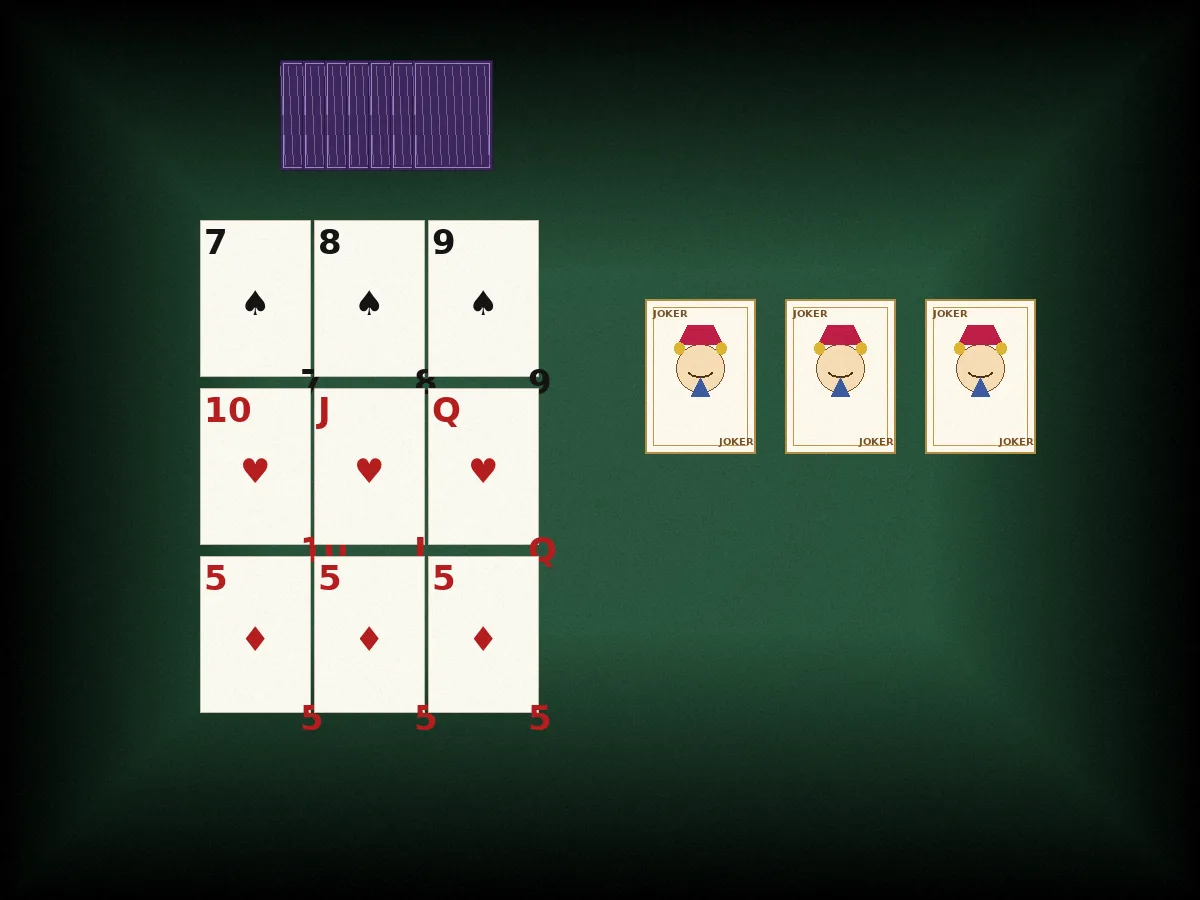
Wild joker
The face-up card from the discard pile is the wild joker for the deal. All printed jokers of the same rank become wild and can substitute in any impure sequence or set.
Closed deck
The face-down stack from which players draw cards. The closed deck shrinks as the deal progresses.
Discard pile
The face-up stack of discarded cards. The top card is available for the next player to draw. The pile is the public information at the table.
First drop
A player who drops before picking their first card. Penalty: 20 points.
Middle drop
A player who drops after picking at least one card. Penalty: 40 points.
Full count
A player who declares a show but has an invalid hand. Penalty: 80 points.
Show
A declaration of a valid hand. The cards are arranged into melds; the validator checks the arrangement. A successful show ends the deal.
Points cap
The maximum score awarded for a single declaration. The cap was historically 60; several platforms have raised it to 80.
The format vocabulary
Points rummy
A single deal. Each player pays for the value of the cards left in hand at the show. The points cap applies.
Pool rummy
Played until a player or team reaches the elimination score (101 or 201). Each deal settles into the pool; the loser of the deal takes the full score.
Deals rummy
Three deals per game. The chips move with the score; the player with the most chips at the end of the third deal wins.
Gin rummy
A ten-card variant. Knock when deadwood is ten or less; undercut the knocker with a lower deadwood count to win double.
Teen patti
A three-card hand. Trail, blind, seen, packed. Variations include AK47, Muflis and 3+2 Joker.
Andar bahar
A single joker card is dealt face-up. Cards are dealt alternately to the Andar and Bahar sides until a matching suit appears. The side that receives the match wins.
The verification vocabulary
KYC
Know Your Customer. The four-step process every mainstream platform asks for before the first withdrawal: PAN, Aadhaar, bank or UPI, selfie.
PAN
Permanent Account Number. The PAN card is the only document every mainstream platform asks for at registration.
Aadhaar
The Indian national identity document. Aadhaar is requested as address proof at the second KYC layer.
UPI
Unified Payments Interface. The default withdrawal method on most mainstream platforms.
Self-exclusion
A voluntary block on the reader's account for a chosen period: six months, one year or five years.
Deposit cap
A maximum the reader sets for themselves: per deposit, per day, per week or per month.
FAQ
What is a meld?
A meld is a valid grouping of cards: a sequence (consecutive same-suit cards) or a set (same-rank cards of different suits). A valid declaration is made up of melds.
What is a pure sequence?
Three or more consecutive cards of the same suit with no jokers. A pure sequence is required for a valid declaration.
What is an impure sequence?
Three or more consecutive cards of the same suit with at most one joker substituting for a missing card. An impure sequence is allowed in a declaration.
What is the points cap?
The maximum score awarded for a single declaration. The cap was historically 60; several platforms have raised it to 80.
What is a full count?
A player who declares a show but has an invalid hand. The penalty is 80 points.
Strategy vocabulary
Deadwood
The cards in a gin rummy hand that are not part of any meld. The objective is to reduce deadwood to ten or fewer points so the reader can knock. The lower the deadwood, the stronger the hand.
Knocking
The act of ending a gin rummy hand by declaring that the deadwood is ten or fewer. The knocker's deadwood is compared to the opponent's; the lower deadwood wins.
Undercutting
In gin rummy, a player who can lay off cards after the opponent has knocked and end up with equal or lower deadwood. The undercut wins double.
Lay off
In gin rummy, adding cards from the hand to the opponent's melds after they have knocked. A lay off reduces the lay-off player's deadwood.
Big gin
A gin rummy hand where all ten cards are part of melds. The big gin pays double the standard gin bonus.
Trail
In teen patti, a three-of-a-kind. The highest possible trail is three aces.
Pure sequence (teen patti)
Three consecutive cards of the same suit, no jokers. A pure sequence ranks above a normal sequence.
Sequence (teen patti)
Three consecutive cards, not all of the same suit. A sequence ranks above a colour.
Colour (teen patti)
Three cards of the same suit, not in sequence. A colour ranks above a pair.
Pair
Two cards of the same rank. A pair ranks above a high card.
High card
When no hand has a pair or higher, the highest card wins.
AK47
A teen patti variation where a hand containing an ace, a king and a seven (in any combination) is the highest possible hand.
Muflis
A teen patti variation where the lowest hand wins. The ranking is inverted from the standard teen patti ranking.
3+2 Joker
A teen patti variation where three jokers and two regular decks are used. The variation adds a wild card mechanic similar to rummy.
Trail (rummy)
In some platforms, the term "trail" is used to mean a set (three or four cards of the same rank). The usage is platform-specific.
Second drop
Some platforms penalise a second drop in the same deal more heavily than the first. The penalty is platform-specific; the reader should check the rule sheet before the second drop.
Re-buy
In pool rummy, the act of buying back into the pool after the chips reach zero. Most platforms allow one re-buy per pool; some allow two.
Mis-deal
A deal where an error has occurred (wrong number of cards, exposed card, wrong wild joker). The dealer position rotates and the cards are re-dealt.
Split pot
A show where two or more players have equal valid hands. The pot is split between the winners.
Void
A suit that the reader is not holding. A void suit is sometimes declared at the show to indicate the reader's hand composition.
Round
A single turn cycle where every player has drawn and discarded. A round usually contains between six and ten turns in standard play.
Platform-specific vocabulary
Timer
The countdown clock that limits a player's turn. The default timer on most reviewed platforms is 30 seconds. The timer can usually be configured to 60 or 90 seconds. A player who runs out of time on their turn is auto-folded by the platform.
Auto-fold
The platform's automatic response to a player who runs out of time. The auto-fold discards the highest card from the player's hand. The auto-fold is not the same as a middle drop; the cost is the value of the discarded card rather than a fixed 40 points.
Reconnect window
The period during which a disconnected player can return to the table without losing their hand. The reconnect window on most reviewed platforms is 30 seconds. A player who does not reconnect within the window is auto-folded.
Cash table
A table where the chips have a real-money value. A cash table is the default table type on every reviewed platform.
Practice table
A table where the chips have no real-money value. A practice table is offered by every reviewed platform as a way for new readers to learn the rules without risking real money.
Tournament
A multi-table event with a fixed entry fee, a fixed starting chip count and a payout structure. Tournaments are offered by every reviewed platform; the desk covers tournament structure but does not recommend specific tournaments.
Leaderboard
A ranked list of players based on a metric (winnings, hands played, biggest win). Leaderboards are platform-internal; the desk does not publish a cross-platform leaderboard.
VIP programme
A loyalty programme offered by some platforms. The VIP programme usually offers cashback, exclusive tournaments and priority support. The desk does not score the VIP programme as part of the review; the desk scores the platform on the five columns only.
Bonus
A promotional credit offered by the platform. Bonuses usually come with a wagering requirement (the bonus must be wagered a fixed number of times before it can be withdrawn). The desk does not score bonuses; the desk treats bonuses as marketing rather than as a platform feature.
Wagering requirement
The number of times a bonus must be wagered before it can be withdrawn. A wagering requirement of 10x on a ₹500 bonus means the reader must wager ₹5,000 before the bonus can be withdrawn. The desk recommends reading the wagering requirement before accepting any bonus.
Cashback
A percentage of losses returned to the reader. Cashback is usually calculated on a weekly or monthly basis. The desk treats cashback as a loyalty feature rather than as a value-add; the cashback should be considered alongside the wagering requirement.