i
Pure sequence present?
At least one pure sequence (no jokers) is required.
A walkthrough written for a reader who has never sat at the table before. Each step is small, each step has a verification point at the end. By step thirteen, the rules are no longer a wall of text; they are a series of small, verifiable moves.
Two decks of standard playing cards are shuffled together with two printed jokers. One card is drawn to decide the dealer; the highest card deals. The dealer position rotates clockwise after every deal.
A single joker is dealt face-up between the closed deck and the discard pile. This card is the wild joker for the deal: any printed joker of the same rank becomes wild. The remaining cards form the closed deck.
Two to six players can play a standard points-rummy table. Pool tables usually seat six; deals tables usually seat six as well.
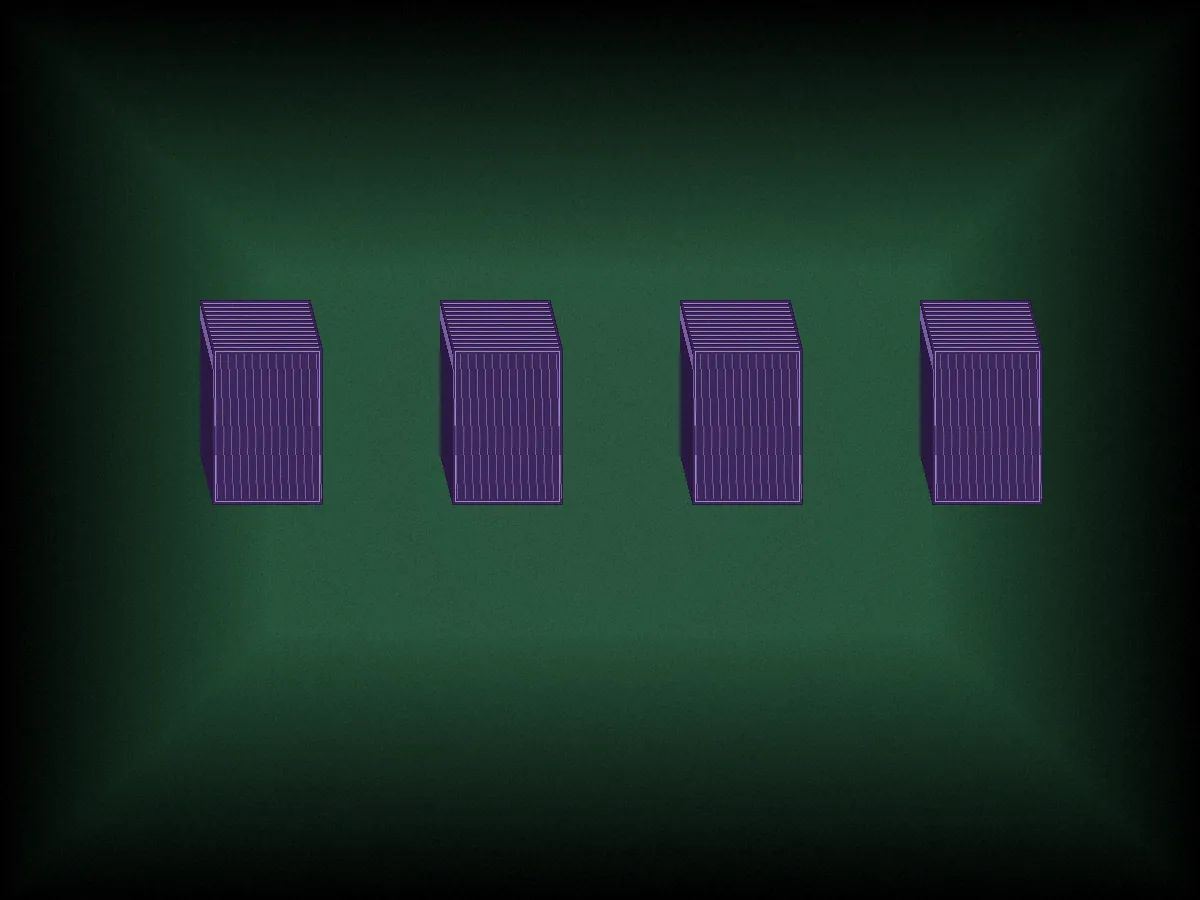
Before the deal, every player should see: two decks in the deck stack, the wild joker face-up beside the closed deck, the dealer announcement, and the table stake.
Thirteen cards are dealt to each player, one at a time, clockwise starting with the player to the dealer's left. The remaining cards become the closed deck; the top card of the closed deck is turned face-up to start the discard pile.
The first useful habit is sorting the hand into groups by suit and rank. A clean sort makes the next twelve steps possible. Most players sort by alternating colours so a sequence can be read at a glance.
Each player holds thirteen cards. The discard pile has one card. The closed deck has the remainder.
On each turn, the player draws one card, either the top card of the closed deck, or the face-up card on the discard pile. Drawing from the discard pile is the only way to see what your opponent has discarded; it is also the only way to take a wild joker.
A draw from the discard pile is usually taken when the discarded card completes a sequence or set, or when the card is the wild joker. A blind draw from the closed deck is preferred when the hand is already sorted and the player wants to keep options open.
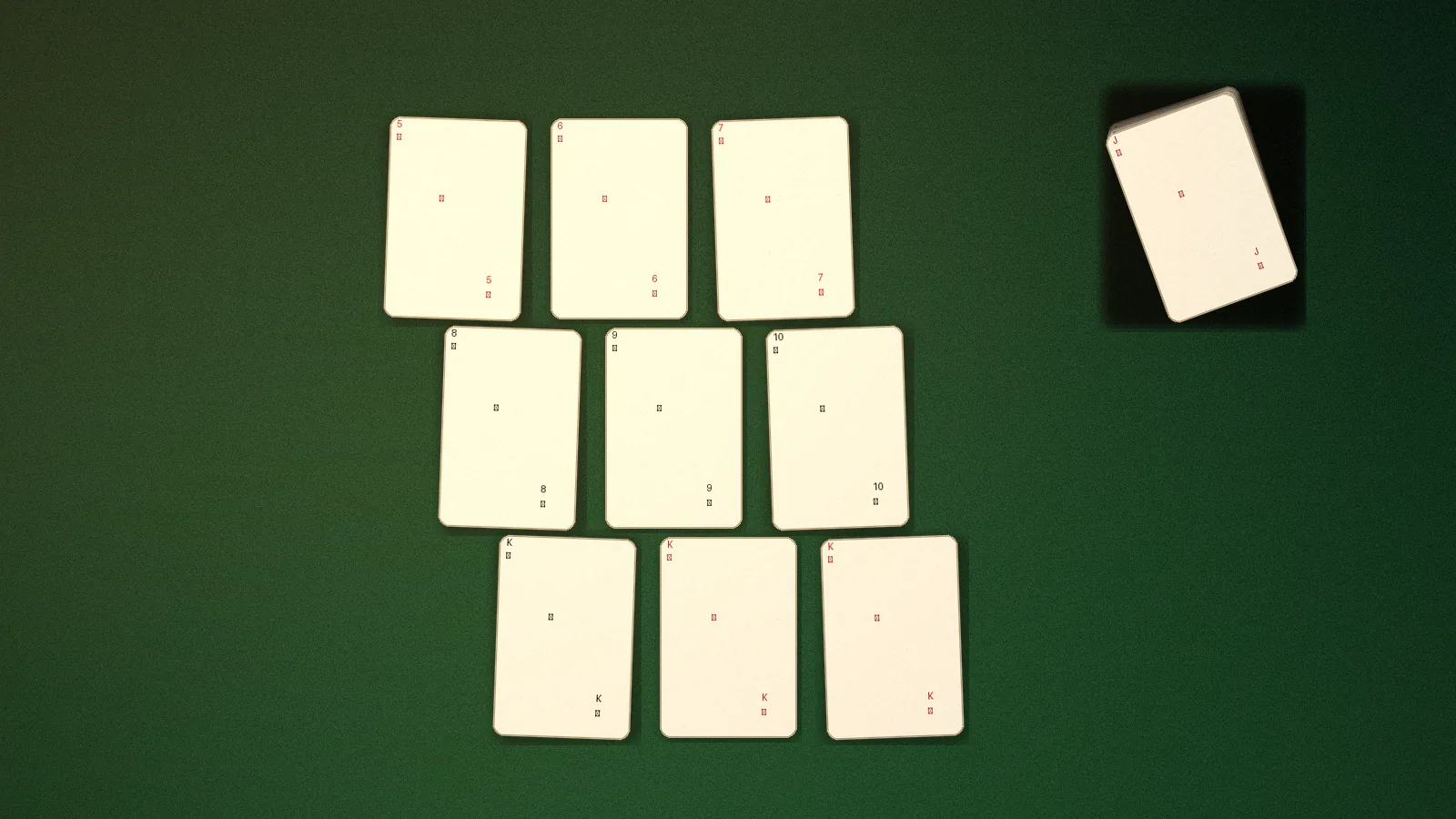
After the draw, the player discards one card face-up onto the discard pile. The discard is the player's main signal: a high card says "I cannot use this"; a low card says "I have already sorted my hand."
A player may drop mid-game if the hand looks unworkable. The first drop (before any draw) costs 20 points; the middle drop (after at least one draw) costs 40 points. The full count, declared but invalid, costs 80 points.
After the discard, the discard pile has grown by one. The hand has thirteen cards. The closed deck has one fewer card.
A player who believes their hand is valid declares a show on their turn. The cards are arranged into sequences and sets. A valid declaration requires at least one pure sequence and the rest of the hand organised into valid sequences or sets.
A pure sequence is three or more consecutive cards of the same suit, no jokers. An impure sequence is three or more consecutive cards of the same suit with at most one joker substituting for a missing card. A set is three or four cards of the same rank, different suits, with at most one joker.
A declaration without at least one pure sequence is invalid. A declaration with two jokers in one impure sequence is invalid. A declaration where a card appears in two groups is invalid.
The cards are laid out in groups. The validator checks: at least one pure sequence; no double-counted cards; no more than one joker per impure sequence or set.
The loser pays the winner the value of the unmatched cards left in hand. Face cards and aces count as ten; number cards count as their face value; jokers count as zero. The total is capped by the points cap.

A player who declares a show but has an invalid hand is the loser. The full count is 80 points (or the points cap, whichever is lower). The full count is a powerful discipline tool. A player who is uncertain about their hand should drop instead of guessing.
At least one pure sequence (no jokers) is required.
Each set or impure sequence uses at most one joker.
Each card appears in exactly one group.
The total of unmatched cards does not exceed the cap.
The show is declared on your turn, before the draw or after the discard.
The strategy ledger expands on what to do with thirteen cards once the rules are clear.
Thirteen. Two decks of cards are shuffled together with two printed jokers and a face-up wild joker; the remainder is the closed deck.
The face-up card from the discard pile is the wild joker for that deal. All jokers of the same rank become wild.
At least one pure sequence, plus the rest of the hand organised into valid sequences and sets. Face cards count as ten; aces count as ten or as one in an impure sequence.
A player can drop before picking their first card (first drop, 20 points) or after picking at least one card (middle drop, 40 points).
A player who declares a show but has an invalid hand. The penalty is 80 points.
If the closed deck runs out before a player declares a show, the discard pile is shuffled (except the top card) and turned face-down to become the new closed deck. The game continues from the same position.
If a player disconnects mid-game, most platforms have a thirty-second reconnect window. If the player does not reconnect within the window, the platform folds the hand for the player at the current state. The disconnected player's cards are not shown to the table.
No. The cards are private to each player. A player who exposes their cards to another player during a show is considered to have shown illegally; the show is invalidated.
A mis-deal occurs when an error has been made at the deal stage, for example, an incorrect number of cards, an exposed card, or an incorrect wild joker. The dealer position rotates and the cards are re-dealt. The previous deal's score does not carry over.
A split pot occurs when two or more players have equal valid hands at the show. The pot is split between the winners according to the platform's split-pot rule. Most platforms split equally; some split by chip count.
No. A show must be declared on the player's turn, either before drawing or after discarding. A player who declares a show without having taken any action on their turn has made an invalid declaration and incurs the full-count penalty.
A middle drop costs 40 points and is taken by a player who decides the hand is unworkable. A full count costs 80 points and is the penalty for a player who declares a show but has an invalid hand. The full count is more expensive because the player has actively committed to the hand by declaring.
Yes. A player may re-arrange their hand at any time during their turn, before the draw, between the draw and the discard, or after the discard. The re-arrangement is not visible to other players.
The timer default varies by platform. Most mainstream platforms default to 30 seconds per turn. Some platforms offer 60-second or 90-second timers for readers who prefer a slower pace.
If a player runs out of time on their turn, the platform automatically picks from the closed deck (if no card is in hand) and discards the highest card from the hand. The player can override this by taking their action within the grace period.